
You are in the right place.
If you found this page, you are probably someone who is curious — maybe you heard about the Native American Church through a friend, saw something that stirred a question, or you simply felt drawn to understand more. That kind of quiet, respectful curiosity is welcome here.
This guide is written for people who are new to this world. We will not speak in academic jargon, and we will not pretend this subject is simple. The Native American Church carries real history, living communities, and deep spiritual responsibility. What we can do is give you an honest, grounded orientation — and point you toward what matters most.
One thing you will hear often in this tradition: Mitákuye Oyás'iŋ. It is a Lakota phrase that means "all are related." It is also the name of our chapter. It is a good place to start.
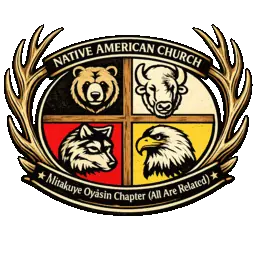
Bear · Bison · Wolf · Eagle
The four sacred animals of our chapter seal,
representing the four directions and the circle of life.
What is the Native American Church?
The Native American Church is an intertribal Indigenous religious tradition. It grew most visibly in the United States during the late nineteenth and early twentieth centuries, becoming a spiritual home for prayer, healing, community, and moral discipline in the face of colonization, forced assimilation, and cultural disruption.
The word intertribal matters. It means this tradition was shared across many Native nations — Comanche, Kiowa, Lakota, Navajo, and many others — while each community kept its own ceremonial character. There is no single uniform practice. There is, instead, a shared spiritual ethic: prayer, responsibility, relationship with the Creator, and care for one another.
What it is not: a museum piece, a trend aesthetic, or a loose spiritual system that anyone can pick up casually. The Native American Church is a living spiritual community grounded in lineage, elder guidance, and community accountability. The safest thing a newcomer can understand is this — there is more here than a short webpage can hold, and that is by design.
"For newcomers, the safest starting point is this: the Native American Church is a living spiritual community, not a museum, trend aesthetic, or generalized 'shamanic' system. It is grounded in responsibility, lineage, and community ethics."— Educational Guide on the Native American Church
Peyote and the Peyote Road
Peyote is a small spineless cactus native to parts of northern Mexico and south Texas. Archaeological evidence shows it has been used in Indigenous sacred life for thousands of years — long before modern legal debates, long before organized religious structures.
In this tradition, peyote is not understood as a substance. It is understood as a sacrament — sacred medicine approached with prayer, intention, and reverence. Its purpose is not novelty or altered experience for its own sake. Its purpose is right relationship: with the Creator, with the community, and with oneself.
Many peoples have contributed to the transmission of peyote ceremonialism across history — the Wixárika (Huichol), the Lipan and Mescalero Apache, the Comanche and Kiowa, and others. No single people owns this history, and no short summary does justice to its complexity.
The Peyote Road
Many people in this tradition use the phrase "the Peyote Road" to describe not just ceremony, but the moral path that surrounds it.
- Prayerfulness and humility
- Personal accountability
- Care for family and community
- Respect for elders and lineage
- Sobriety and disciplined conduct
- Service and quiet generosity
The road is not just what happens in ceremony. It is how you live between ceremonies.
Ceremonies and Gatherings
Ceremonies in the life of the Native American Church are not events to attend like a concert or a class. They are sacred responsibilities — obligations of presence, prayer, and relationship. The following gives you a sense of what kinds of gatherings are part of this world, offered as orientation, not instruction.
The All-Night Meeting
The ceremony most associated with the Native American Church. An overnight prayer service — typically held in a tipi around a ceremonial fire — centered on song, prayer, and community. It is led by a roadman, and runs from dusk through sunrise. The tone is disciplined, reverent, and deeply communal.
Healing Meetings
Meetings held with a specific person or need in mind. Prayer, song, endurance, and support gather around illness, grief, addiction, family hardship, or spiritual imbalance. Healing here is understood not as a quick fix but as a collective responsibility — the circle around someone who is struggling.
Thanksgiving Gatherings
Prayer centered on gratitude rather than petition. These may mark recovery, safe return, a family milestone, or simply the blessing of being alive. Thanksgiving is woven into the everyday ethic of this tradition — humility before the Creator is not reserved for special occasions.
Song & Testimony
Peyote songs — accompanied by a water drum and gourd rattle — are a defining feature of many meetings. Testimony, witness, and spoken prayer may also be part of the night. These are not performances. They are the way a community prays together, remembers, and carries teaching forward.
Morning Breakfast
The ceremonial night ends with a shared meal. This is more than practical — it is the return from sacred time into daily life. Shared food and fellowship are expressions of care, kinship, and relationship. How people receive and feed one another is part of the ceremony, not separate from it.
Memorial Observances
When someone in the community passes, prayer gathers around loss. Practices vary by family and nation, but the shared ethic is the same: grief is held communally. Newcomers should understand that bereavement observances carry specific protocols and should always be approached with care and permission.
The Sweat Lodge & Other Sacred Practices
The Native American Church often exists alongside other sacred Indigenous traditions. The sweat lodge — known in Lakota as Inípi, meaning "to live again" — is among the most ancient. A domed structure of bent willows, heated stones, steam, and darkness: it is a ceremony of purification, humility, and renewal that has been practiced by Indigenous peoples across North America for thousands of years.
Among the Lakota Sioux, Inípi is one of the Seven Sacred Rites transmitted through White Buffalo Calf Woman. It cleanses participants before other major ceremonies, preparing the body and spirit for what is to come. The heat and darkness are not obstacles — they are the ceremony. Participants emerge from darkness into light as an act of spiritual rebirth.
It is important to understand: related traditions are not interchangeable. A sweat lodge and a peyote meeting come from different peoples, histories, and ceremonial authorities. A church may honor more than one spiritual inheritance, but that does not mean every rite is the same, or that one tradition belongs to another.
Inípi — "To Live Again"
This is not spectacle.
One of the most common mistakes outsiders make is treating Indigenous ceremonies as if they are a set of steps to follow — what to burn, what to take, what direction to face. That framing misses the point entirely.
Ceremony is not a procedure. It is permission, relationship, lineage, vow, language, and responsibility. The meaning is not in the outward action alone. It lives in the people who carry it — the elders, the families, the communities who have been given the authority to hold it.
This guide does not hand you a ceremony. It gives you context, and we hope it gives you respect. Deeper learning belongs in living community settings, not casual public imitation. When you are ready to take a real step — we invite you to reach out.
There is also a conservation note worth naming: peyote is slow-growing, ecologically vulnerable, and sacred to living communities. Respect for this tradition includes protecting the land, the harvest, and the Indigenous stewardship that sustains it.
"Our chapter honors Native spiritual responsibility, prayer, and reverence for what is sacred. We recognize that the Native American Church carries deep history, distinct lineage, and living responsibilities that cannot be reduced to stereotypes or public imitation."
Where We Come From
Mitákuye Oyás'iŋ Chapter is a chapter of New Haven Native American Church, based in Eastern Missouri. Our chapter stands within a documented line of recognition connecting us to the Native American Church at the Rosebud Reservation of South Dakota (established 1924), through a series of blessings, affidavits, and organizational records across nearly a century.
Our first Principal Stone Carrier is Thomas "Bear That Paces Back and Forth" Tovar, certified into full fellowship membership and chapter leadership through New Haven Native American Church. We understand our work as one of reverence, stewardship, prayer, ceremony, and service — carried out in alignment with the parent church's mission and spiritual order.
Our community is small, intentional, and growing. We welcome respectful inquiry.
Reach Out to UsWords Worth Knowing
These terms come up often when learning about this tradition. Tap any term to read its plain-language meaning.
Ready to Learn More?
We welcome questions, respectful conversation, and genuine inquiry. The best way to understand this community is to be in relationship with it.